
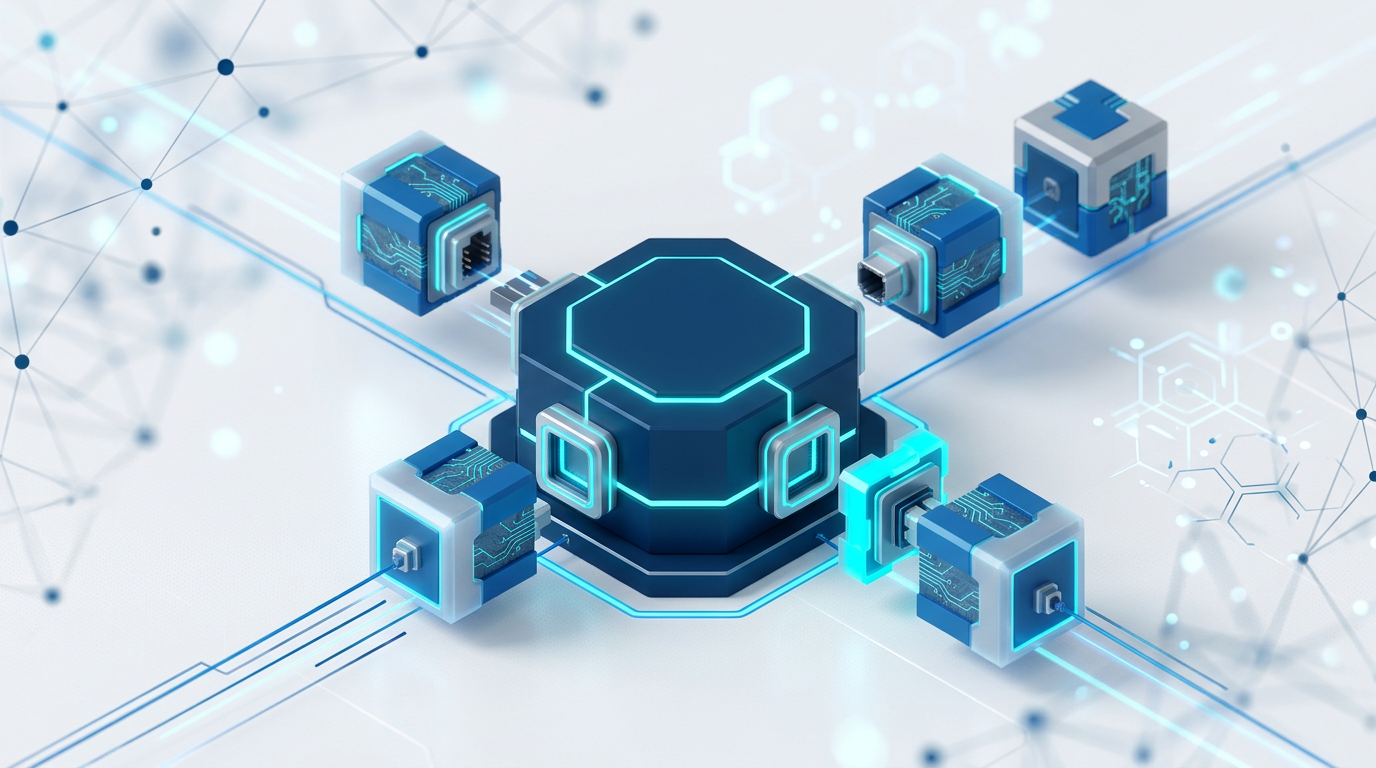
The DeepSeek Harness framework is a TypeScript-based orchestration platform for building highly modular AI agents. Utilizing the Cordis framework, it operates on an "everything is a plugin" architecture, allowing engineering teams to decouple core logic from third-party integrations to rapidly scale production-ready AI applications.
As artificial intelligence transitions from standalone chatbot interfaces to complex, multi-agent workflows, CTOs and engineering leaders face a critical architectural challenge. Monolithic AI codebases quickly become impossible to maintain, test, and scale. DeepSeek Harness (DSH) resolves this by enforcing strict modularity, but leveraging it requires a specific caliber of software engineering talent.
Key Takeaways for Engineering Leaders
- Plugin-First Architecture: DSH treats every component—from LLM connectors to database adapters—as an independent, interchangeable plugin.
- Powered by Cordis: The framework relies heavily on lifecycle management and dependency injection provided by the Cordis ecosystem.
- TypeScript Dominance: Strict typing is no longer optional for AI; it is mandatory for structured LLM outputs and predictable agent behaviors.
- Specialized Talent Required: Building with DSH requires hiring engineers skilled in enterprise TypeScript, Inversion of Control (IoC), and distributed systems, rather than just prompt engineers.
- Faster Iteration: Modular architectures allow distinct squads to work on separate plugins simultaneously, drastically reducing time-to-market.
The Core Philosophy: Everything is a Plugin
The defining characteristic of the DeepSeek Harness framework is its uncompromising dedication to modularity. In traditional AI application development, developers often hardcode API calls to language models, vector databases, and external tools within the same execution block. This creates massive technical debt.
DSH upends this by enforcing a plugin architecture. In this ecosystem, a plugin is an isolated unit of functionality that registers its capabilities to a central context and requests the capabilities it needs from other plugins. This means your core business logic never directly imports your OpenAI or DeepSeek model clients.
Instead, your logic requests a generic "chat" or "completion" service. A separate plugin provides that service. If you need to swap from OpenAI to an open-source model running locally, you simply swap the provider plugin. No business logic needs to be rewritten, tested, or redeployed.
The Role of Contextual Isolation
Contextual isolation is a massive advantage for enterprise engineering teams. When you hire developers to scale an AI product, you want them working in parallel without causing merge conflicts or cascading failures.
In DSH, contexts can be nested and isolated. A database plugin can be injected globally, while an experimental retrieval-augmented generation (RAG) plugin can be confined to a specific sub-context. If the RAG plugin crashes, the global context and the rest of the application remain stable.
Deep Dive: Cordis and Inversion of Control
To understand DSH, engineering leaders must understand Cordis. Cordis is the underlying engine that powers the DeepSeek Harness framework. It is a highly robust lifecycle management and dependency injection container built specifically for TypeScript and Node.js environments.
Cordis implements a software design principle known as Inversion of Control (IoC). Rather than a central application script importing and initializing dependencies one by one, plugins declare what they need, and the Cordis container provides those dependencies at runtime.
This inversion fundamentally changes how AI agents are built:
- Lifecycle Hooks: Plugins have distinct states (install, start, ready, dispose). Cordis manages these transitions automatically.
- Hot Reloading: Because dependencies are tracked and injected dynamically, plugins can be enabled, disabled, or updated at runtime without restarting the entire Node process.
- Service Discovery: Plugins automatically discover each other based on TypeScript interfaces, eliminating the need for rigid configuration files.
For CTOs, this translates to massive operational resilience. Memory leaks and hanging asynchronous operations—common plagues in long-running AI agent frameworks—are mitigated by strict dispose lifecycle hooks enforced by the framework.
Architectural Comparison: DSH vs. Traditional Chains
Many engineering teams start their AI journey with frameworks based on "chains" or monolithic loops. Below is a realistic look at how the DeepSeek Harness framework compares to traditional approaches when scaling to enterprise production.
| Architectural Feature | DeepSeek Harness (Plugin-Based) | Traditional Chain Frameworks | Custom Microservices |
|---|---|---|---|
| State Management | Managed by isolated contexts and lifecycle hooks | Often global or passed manually through chain links | Fully decentralized, requiring external stores (Redis) |
| Extensibility | High: Drop in a new plugin without touching core code | Medium: Requires modifying chain definitions | High: But requires managing network overhead |
| Type Safety | Native end-to-end TypeScript enforcement | Often mixed or loosely typed (Python dominant) | Depends entirely on API contracts (gRPC/GraphQL) |
| Testing | Unit testable via simple dependency mocking | Difficult: Requires complex LLM mocking | Requires integration testing environments |
| Runtime Updates | Hot-swappable plugins via Cordis | Requires full application restart | Requires container orchestration (Kubernetes) |
Why TypeScript Dominates Modular AI
The choice of TypeScript for the DeepSeek Harness framework is not accidental. While Python remains the undisputed king of model training and data science, TypeScript has rapidly become the standard for building the application layer and orchestrating AI agents.
LLMs are inherently unpredictable engines of text generation. To use them in reliable software, we must force them to produce structured data, typically JSON. TypeScript provides an incredibly rich, static type system that maps perfectly to JSON Schema.
When utilizing DSH, developers use TypeScript interfaces to define exactly what an agent's plugin configuration should look like, and exactly what data shapes the LLM must return. The framework can automatically validate these configurations at startup and at runtime.
Type Inference and Developer Experience
Beyond safety, TypeScript offers an unmatched developer experience. Because DSH plugins declare their dependencies as typed services, modern IDEs provide instant autocomplete for available methods. A developer writing a customer support plugin instantly sees the methods available on the injected `database` or `email` services.
This reduces onboarding time for new engineers. When you expand your team through custom software development services, new developers can confidently write plugins on day one because the TypeScript compiler prevents them from passing the wrong context or violating lifecycle constraints.
Technical Skills Needed to Build with DSH
Adopting a modern, plugin-based AI architecture requires a shift in hiring criteria. Many companies make the mistake of hiring "Prompt Engineers" or Python data scientists to build their application backends. To succeed with the DeepSeek Harness framework, you need highly capable backend software engineers.
When evaluating candidates for these engineering roles, hiring managers should focus on the following core competencies:
- Advanced TypeScript: Generics, utility types, conditional types, and rigorous interface design. The candidate must be comfortable writing code that is strictly typed without relying on
any. - Dependency Injection (DI): Experience with IoC containers (like NestJS, Inversify, or Cordis itself). They must understand how to decouple implementation from abstraction.
- Asynchronous Programming: Mastery of Node.js event loops, Promises, and memory management in long-running processes. AI agents often wait seconds or minutes for external API responses.
- Event-Driven Architecture: Understanding how to emit, listen, and react to events across different contexts without creating tightly coupled codebases.
If your team currently lacks these specialized skills, partnering with a firm that provides vetted, senior engineering talent is the most reliable path to production.
Structuring Your AI Engineering Team
Because the DeepSeek Harness framework is strictly modular, it naturally dictates how you should structure your engineering organization. Conway's Law states that software architecture reflects the communication structures of the organization that built it. DSH allows you to use this to your advantage.
You can divide your engineering department into highly focused, autonomous squads:
The Core Platform Team: Responsible for maintaining the Cordis runtime, defining global interfaces, and managing deployment pipelines. They ensure the "chassis" of the application is stable.
The Capability Providers: A team dedicated to writing base plugins. They build the integrations for vector databases, external APIs, LLM providers, and authentication systems. They provide the "tools."
The Agent Developers: Product-focused developers who compose these plugins into specific business workflows. They write the prompts, configure the contexts, and string together the capabilities to solve user problems.
This separation of concerns prevents bottlenecks. The Agent Developers don't need to understand the complex retry-logic of the vector database; they just inject the database service and call its generic search method.
Deployment and CI/CD for Plugin-Based Agents
Moving a modular AI agent into production requires a mature deployment strategy. Because plugins are independent, traditional monolithic CI/CD pipelines can become inefficient.
Enterprise teams utilizing DSH typically adopt a monorepo structure (using tools like Turborepo or Nx). Each plugin resides in its own package. When a developer updates a specific capability plugin, the CI pipeline only runs tests for that specific package and any downstream plugins that depend on it.
Furthermore, because Cordis supports robust configuration loading, behavior can be drastically altered in different environments without changing code. Staging environments can load mock LLM plugins that return static text to save API costs during continuous integration testing, while production environments load the real providers.
Accelerating Time-to-Market
The ultimate goal of adopting the DeepSeek Harness framework is speed. By eliminating technical debt through strict interfaces, teams can iterate on AI features faster.
When a new foundation model is released, you do not rewrite your application. You write a single adapter plugin in a matter of hours, inject it globally, and your entire suite of AI agents instantly benefits from the new model. This is how modern tech companies achieve rapid scale and maintain a competitive edge in the fast-moving AI landscape.
If you need to move quickly, leveraging pre-vetted teams capable of a 30-day deployment cycle can ensure your architecture is established correctly from day one, avoiding costly refactors down the line.
Overcoming AI Engineering Talent Shortages
While the architectural benefits of the DeepSeek Harness framework are clear, the barrier to entry remains talent. The intersection of deep TypeScript expertise, architectural design patterns, and modern LLM orchestration is a rare skill set.
Senior TypeScript engineers with AI agent experience command high market rates, and the recruitment process for evaluating nuanced architectural knowledge is heavily resource-intensive for standard HR departments. You need technical leaders who understand Cordis, abstract syntax trees, and contextual isolation to properly interview these candidates.
At Devaigo, we solve this exact problem. We provide AI-powered tech staffing and custom software engineering services, giving you immediate access to pre-vetted senior developers who have hands-on experience building scalable AI architectures.
Ready to build production-grade AI agents without the technical debt? Contact our team today to hire specialized TypeScript AI engineers and scale your development rapidly.